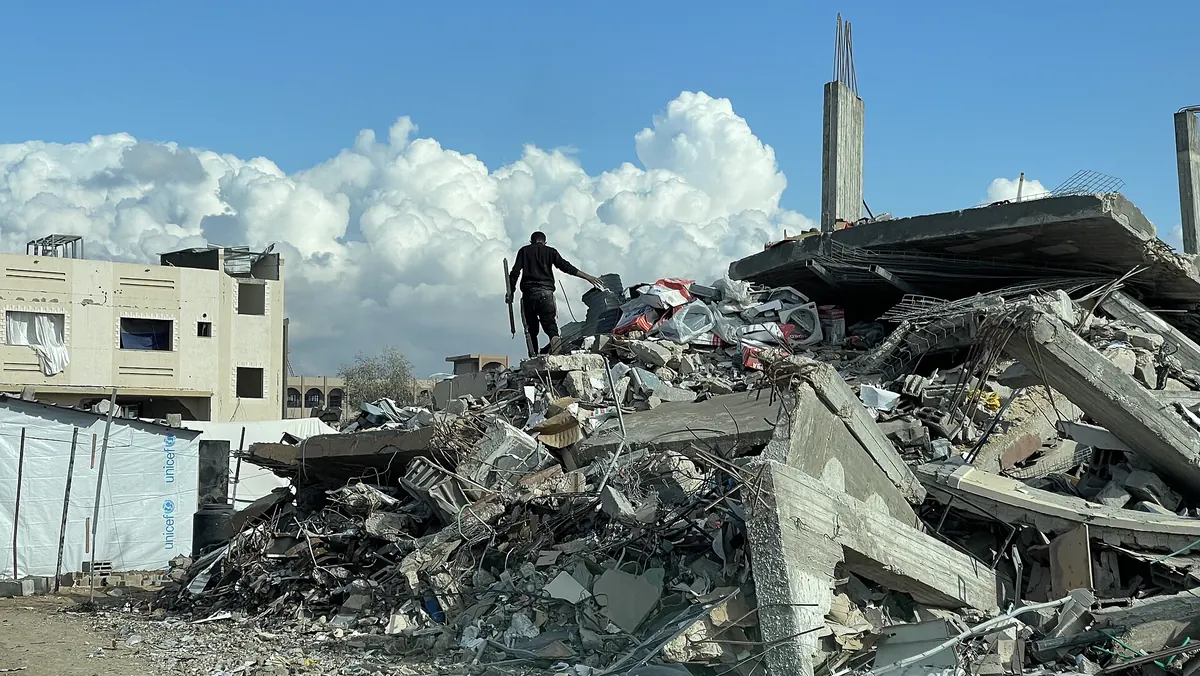
Qassam al-Sane’e, 35, studied IT. In the ruins of Khan Younis he swings a sledgehammer to free iron and tiles a middleman can sell on, one link in a trade that runs from hammer to tent.
Civil servant in Gaza, paid in worn banknotes (name changed)
Gaza
₪1,500every 45–50 days; it was ₪2,000 every 30–35
Mondoweiss, 14 Oct
The rubble trade, one link at a time
With almost no bulldozers working, Khan Younis’s debris is cleared by hand. Each link is a named person, with the day rate he gave the reporter.
Khan Younis · from the hammer to the tent
Qassam al-Sane’e, 35
Breaks the concrete
Former web designer and repair-shop technician, displaced from Rafah; father of six
$20a day, via a middleman
We know it is harmful, we know it is dangerous, but we still work.
Saleh Musbah, 33
Moves the debris
Construction worker before the war; about ten people live on his pay
₪50about $16.50 a day
Fifty shekels, what can that do?
Nahid Nabil Zo’rub, 33
Runs a crew
Ten years in demolition; leads about 15 men. A job that took 2–3 days now takes 3–4 weeks
$16.50–30a day
Now there are no bulldozers, no equipment, nothing.
Tamir Breis, 35
Buys and sorts
Scrap dealer; straightens bent iron and cleans tiles for resale. Displaced nine times
$20a day at most
Before the war, life was much better than this.
Families in tents
Buys what can be used
Tiles cover muddy floors, wood shores up shelters, iron becomes tent frames and furniture
End of the linea chain made by destruction
Source: Fedaa al-Qedra, “Digging through memories and dangers to secure a livelihood from Gaza’s rubble”, The Electronic Intifada, 25 Sep 2026; republished by Countercurrents, 26 Sep. Rates as told by each worker.
Changed trades
What people did before the war, and what they do now. Every row is a person named in a published report, with its date. The whole wall
Ahmad Mohsen, 24
Deir el-Balah, Gaza · Al Jazeera, 3 Oct
Was: Nursing graduate, volunteering at Al-Aqsa Martyrs Hospital
Now: Sits in a shop selling prepaid internet cards
“The first thing I want is to be able to find a stable job with a decent salary.” Source
Rasha Al-Dos, 44
Gaza City · CBC News, 7 Oct
Was: Teacher, out of the classroom during the war
Now: Teaching again at Warda al-Huda, a private school, in a room with one wall covered by a tarp
About a quarter of the pupils she taught before the war did not survive, she says. Source
Ghassan Marwan, 53
Gaza · Al Jazeera, 3 Oct
Was: Goldsmith who built a factory
Now: Carries water over long distances for his family
“After all these years, I am carrying water from far away.” Source
Khaled al-Kurd, 50
Gaza City · CBC News, 2 Oct
Was: Owner of a sewing business
Now: Builds tables and shelves from aid pallets in a WFP cash-for-work factory
“There is a small amount of resources, but it helps us in life.” Source
Hilal al-Zuwaidi, 34
Gaza City · Middle East Eye, 7 Oct
Was: Construction worker and fruit trader
Now: Charges displaced people’s phones; a month’s takings are what he once made in a week
“This is a new kind of job that we didn’t know before the war.” Source
Hakim Mar’i
Tulkarem, West Bank · Al Jazeera, 27 Sep
Was: Labourer inside Israel, until his leg was injured in 2019
Now: Cannot work; has moved four times since Tulkarem camp was emptied in January 2025
Three bodies, three figures, three different questions. The wall shows a hundred people of working age; pick a source and see how many it says have no work. Every count, side by side
Sources: Gaza Ministry of Labour via Palestinian Information Center, 8 Oct; UNCTAD via Al Jazeera, 24 Sep; UNRWA’s Roland Friedrich to Al Jazeera, 27 Sep. The figures measure different things and are not reconciled here.
68 of every 100 out of work: Gaza Ministry of Labour, 8 Oct.
Reported from the workplace
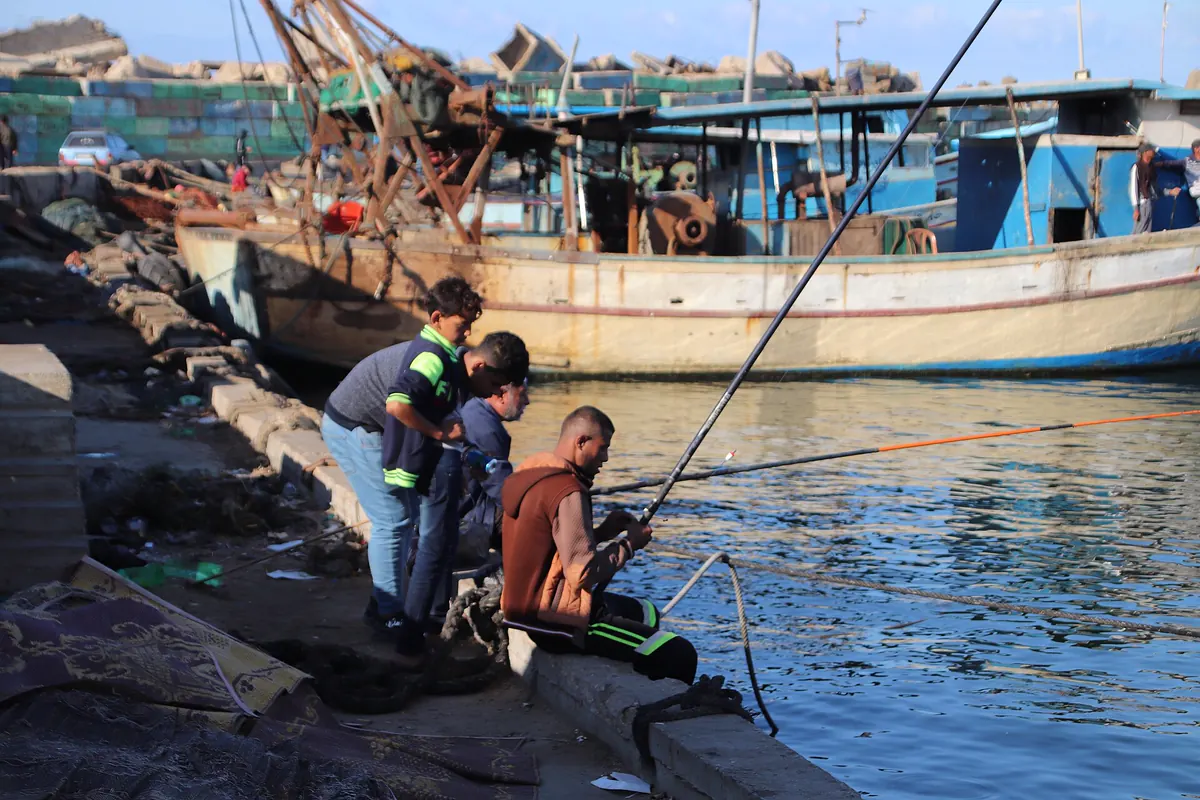
A harbour and a factory floor. The harbour story is from January; nothing on the boats has changed since.
Fishing from the quay of Gaza’s port, December 2019, before the war. Photo: Garry Walsh / Trócaire, CC BY 2.0. Not the fishermen quoted.
Before the war Abu Mohammed, 40, fished to sell his catch. Now he heads out in the early hours, stays within about 500 metres of the shore, and comes back with a meal; on some days with nothing.
Nizar Ayash, who heads Gaza’s fishermen’s union, told the reporter that about 90 percent of boats in Gaza City and the north were destroyed, and estimated the sector’s losses at $75 million.
If we sail, we fear being killed or arrested … And if we don’t, we fear our children will starve.
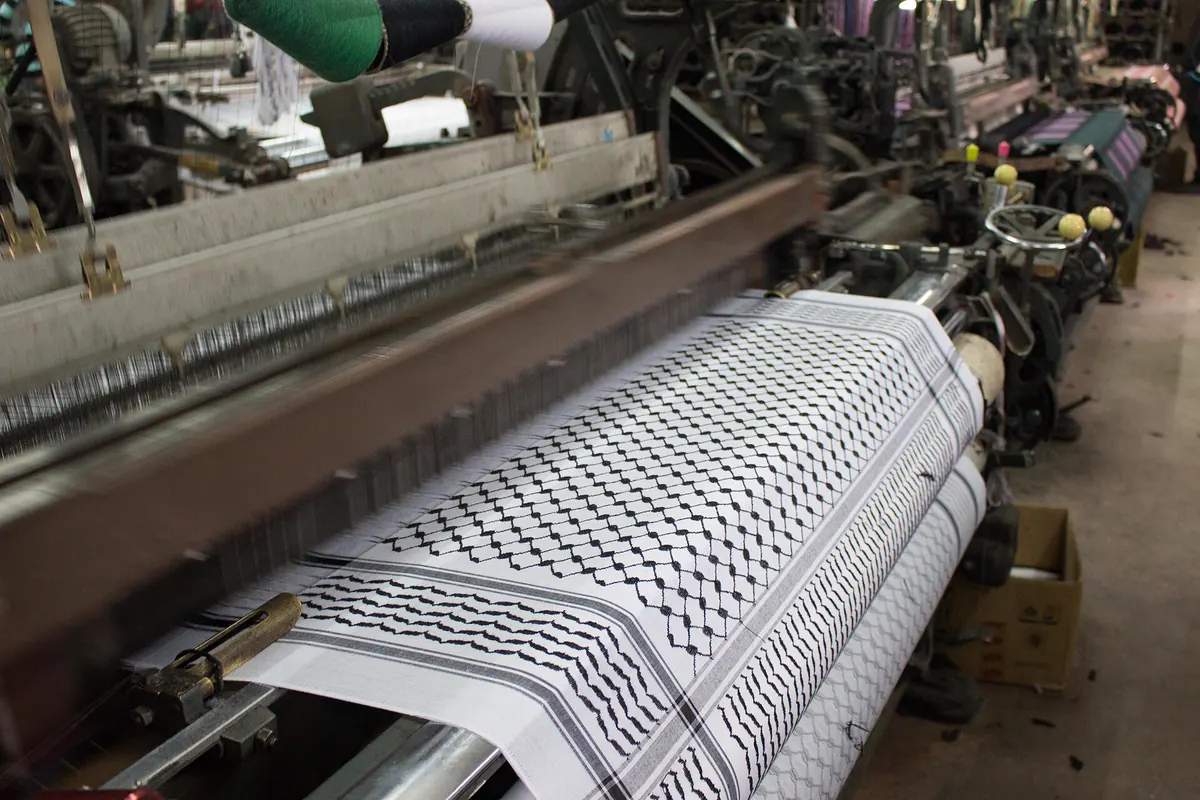
Looms at the Hirbawi keffiyeh factory, Hebron, 2015 (archive). Photo: TrickyH, CC BY-SA 4.0. Not the Gaza factory described.
In a Gaza City factory run by the UN World Food Programme since April, about 113 women and 20 men work three-month shifts unpicking empty flour sacks into bags and turning pallets into furniture that is given away. The pay is 1,000 shekels a month.
Nisreen Abbas, 54, keeps 12 grandchildren and a husband who uses a wheelchair on it: “I bring food for my grandchildren; I bring medicine for my husband.”
I would like for this to be renewed, for us to keep working.
Money and moving
What a payslip, a price and a closed road do to a working week. Money · Moving
Money
PA salaries: June paid in September≥ ₪2,000
Public employees received a share of their June salaries on 23 September, with a floor of ₪2,000.Ministry of Finance via WAFA, 22 Sep
The treasury’s monthly gap₪1.5bn
Needed each month, against ₪800–850 million available for salaries and basic services, the finance minister said.Istifan Salameh to WAFA, 28 Sep
Bread in Gaza₪3
A two-kilo bundle of subsidised bread; 22 bakeries bake about 90,000 bundles a day.OCHA, as of 29 Sep
Petrol 95, West Bank₪7.67/l
From 5 October, down from ₪8.17; diesel and gas unchanged.SadaNews, 9 Oct
Moving
Beit Furik, Nablus
Single gate
The town’s only way in and out. A 15-minute drive routinely took more than five hours, up to ten on the worst days.UN Special Rapporteur statement, 2 Oct
al-Maniya, south-east of Bethlehem
Cut in two
Earth mounds split the village into parts; the main entrance was already closed.WAFA, 8 Oct
Deir Ballut, Salfit
Farm roads blocked
Earth barriers on several roads west of the village in the middle of the olive harvest, keeping farmers off their land.WAFA, 8 Oct
Rafah crossing, Gaza–Egypt
Open, limited
185 people left and 150 entered in the week of 20–26 September, 86 of them medical patients.EUBAM Rafah, 20–26 Sep
There is a gap in the wall. Tell us your work.
This site is built from people, not institutions. If your trade changed, your shop reopened or your shift ended, tell us: a reporter will call before anything is published.